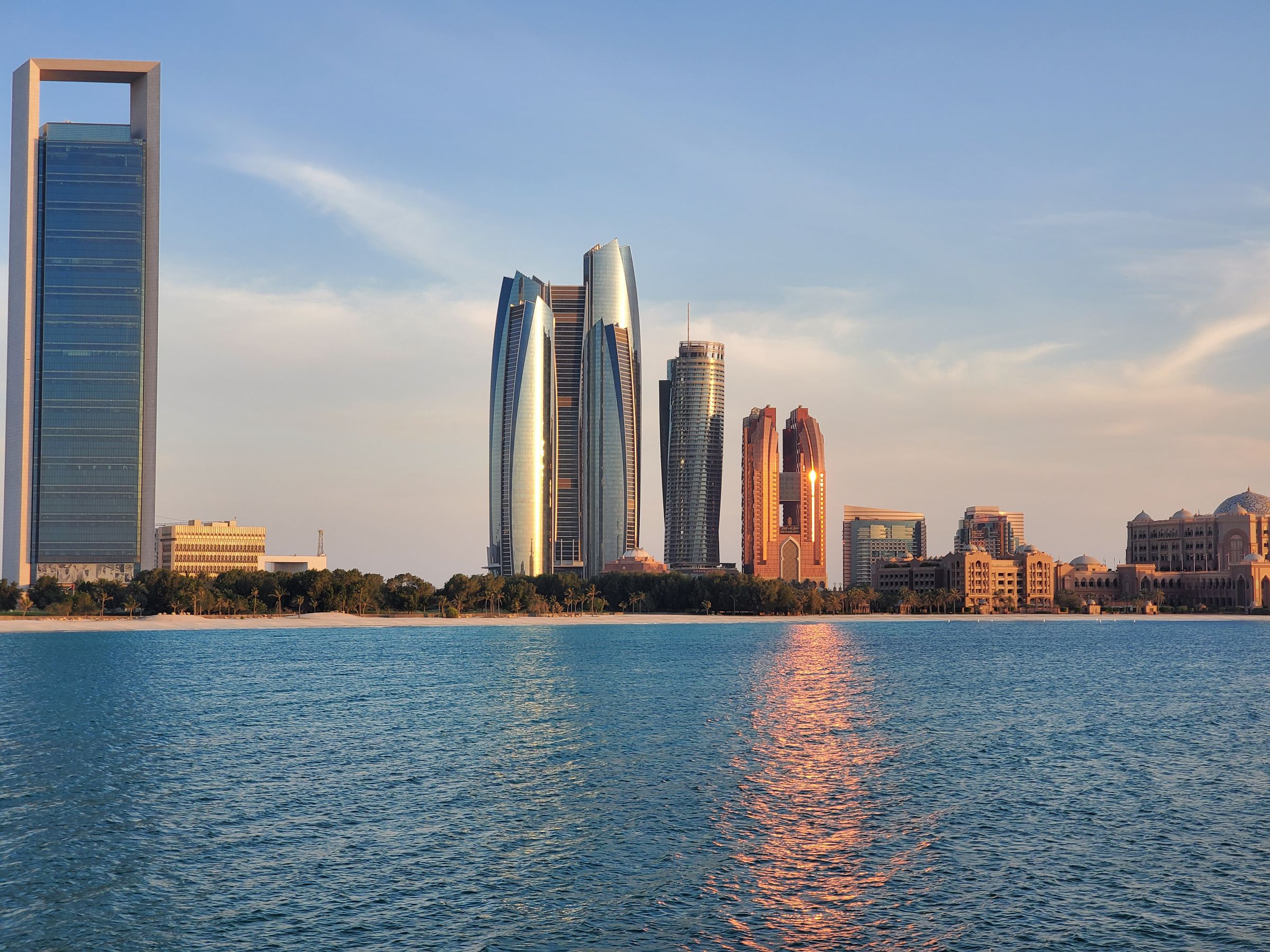
When engineers at Abu Dhabi’s state oil company sat down to plan the development of a new field, the work could stretch across months. Geological data, well characteristics, drilling costs, infrastructure and expected production value were handled by separate teams, each with its own software. Under a partnership announced on November 2, 2026, artificial intelligence is expected to compress that planning cycle into a matter of hours, and the change reaches the daily routines of the specialists who run the United Arab Emirates’ energy industry.
The agreement was unveiled at the ADIPEC 2026 international energy conference in Abu Dhabi, where ADNOC, the technology group G42 and the American company OpenAI announced a multi-year partnership. The signing took place in the presence of Abu Dhabi’s Crown Prince Sheikh Khaled bin Mohammed bin Zayed Al Nahyan, who also met with OpenAI CEO Sam Altman. According to an ADNOC statement, the company will become the first in the energy sector to use the OpenAI Frontier platform to coordinate complex production and commercial processes.
For the people who work in the industry, the shift is practical rather than abstract. AI agents will be able to compare global demand, prices, refinery utilization rates, transportation costs and potential profitability before oil is even extracted, giving analysts faster ways to weigh scenarios. Experts, the company stresses, will retain control over key decisions, with the technology serving as a tool for rapid evaluation rather than a replacement for judgment.
ADNOC has been building toward this for several years. One flagship project, the ENERGYai system developed with AIQ, is based on a language model with 70 billion parameters trained on more than 50 years of company data. The company says it now has over 200 AI applications and 70 robotics use cases implemented or in development, and its real-time operations control center aggregates information from more than 120 drilling rigs. Engineers also use AI to predict malfunctions: if unusual equipment vibration or pressure changes are detected in time, staff can investigate before an accident occurs.
The broader transformation is equally visible on the ground. For decades, oil exports gave the UAE, Saudi Arabia and Qatar the revenues to build investment funds, infrastructure and international business portfolios. But dependence on energy exports carries risks, with revenues fluctuating alongside oil prices and uncertainty growing over future demand as electric vehicles and renewables spread. Building data centers, in turn, requires power plants, cooling systems, telecommunications networks, engineers and cybersecurity specialists, meaning the region’s energy, once exported mainly as oil and gas, becomes a resource for producing digital services.
Money and electricity alone are not enough, however. A competitive AI industry also needs processors, software, research, skilled personnel and clients, which is why the Gulf states are courting international partners. Saudi Arabia’s Public Investment Fund established HUMAIN in May 2025, and HUMAIN and NVIDIA agreed to build computing complexes with up to 500 megawatts of capacity over five years, with the first phase using 18,000 NVIDIA GB300 processors. A competition between the UAE and Saudi Arabia is emerging for investment, equipment, companies and specialists.
In Abu Dhabi, the financing architecture rests on state-affiliated entities. Mubadala Investment Company, a sovereign wealth fund with roughly $385 billion in assets under management as of 2025, agreed with OpenAI and Inception42 on November 2 to use advanced models for investment analytics and risk assessment. The MGX fund, created to invest in AI and related infrastructure, became one of the initial investors in the American Stargate project alongside OpenAI, SoftBank and Oracle. Microsoft announced a $1.5 billion investment in G42 in April 2024, covering collaboration on the Azure cloud platform and AI solutions. The Abu Dhabi government and OpenAI also launched the Machine-Readable Government initiative on November 2, converting regulatory documents into formats AI can process, with a first pilot already underway in food import control.
The most visible symbol of these ambitions is Stargate UAE, announced in May 2025 by G42, OpenAI, Oracle, NVIDIA, Cisco and SoftBank. The plan calls for an AI infrastructure complex in Abu Dhabi with a potential capacity of up to 5 gigawatts, housing a 1-gigawatt computing cluster, with the first 200 megawatts slated for 2026 according to OpenAI’s initial plan. Those figures remain stated intentions rather than completed construction. For residents and officials alike, the stakes are tangible: if the launch succeeds, the computing capacity could serve governments, research organizations and companies abroad, though data centers demand heavy upfront investment and their returns depend on utilization, electricity prices and demand.
Electricity itself is becoming the decisive resource. The International Energy Agency estimates global data center electricity consumption could rise from about 485 terawatt-hours in 2025 to 950 terawatt-hours in 2030. The UAE’s advantage lies partly in its grid, anchored by the Barakah nuclear power plant, whose four reactors exceed 5 gigawatts of installed capacity and supply roughly one-quarter of the country’s electricity, supplemented by natural gas and solar power. High temperatures, however, complicate cooling and raise costs, so cheap energy alone does not guarantee low computing costs.
The partnership also reflects American interests. Building advanced AI requires capital on a scale that makes Gulf sovereign wealth funds a valuable long-term source for companies spending hundreds of billions of dollars, while Arab investors gain access to the technology industry. The U.S.-based Stargate, announced in January 2025 by OpenAI, SoftBank, Oracle and MGX, envisions up to $500 billion in investment over four years, though that figure too is an intention rather than spent funds. Access to NVIDIA’s most powerful processors, which can serve defense as well as civilian purposes, often requires U.S. export licenses.
Security concerns now shape these plans directly. Following Iranian missile and drone attacks in 2026, Reuters reported on September 11, citing six informed sources, that UAE authorities are revising plans for the 5-gigawatt AI campus, considering distributing data centers across the country rather than concentrating them at one site near Abu Dhabi, alongside underground facilities, additional air defenses and backup power and cooling systems. G42 says the first phase of Stargate UAE continues on schedule, though specifications may be revised for security reasons.
For the engineers, planners and residents of the Emirates, the wager is clear. The country aims not merely to fund the AI era but to operate it, and whether those hopes survive contact with energy limits, economics and regional security will be decided in places like Abu Dhabi’s control rooms and construction sites. Further coverage of these developments is available at https://ua.news/en/technologies/vid-nafti-do-shtuchnogo-intelektu-iak-oae-vkladaiut-miliardi-v-openai-ta-peretvoriuiutsia-na-svitovii-tsentr-shi